
Lauderhill Previous-Resident Sources by Era
Different periods leave different records. Start recent Lauderhill work with the parcel card and latest deed. Move backward through recorded transfers, then add directories, census schedules, permits, newspapers, probate, and maps. Ownership and occupancy are separate questions, so the strongest answer uses at least one source for each.
| Source | Time span | Where kept | Evidence supplied |
|---|---|---|---|
| Official Records and ownership documents | Ownership documents since 1883; web access varies by cutoff | Broward Records, Taxes and Treasury | Owners, deed parties, transfer dates, legal descriptions |
| Property roll and sales history | Current roll and parcel history | Broward County Property Appraiser | Current owner, folio, situs, building facts, sale pointers |
| Directories and reverse directories | Exact local runs not verified | Broward County Library and licensed databases | Named adults, occupations, phones, and address entries by edition |
| Federal census | Named schedules through 1950 | NARA and library databases | Enumerated households, relationships, ages, and occupations |
| Permits and code files | Online starting dates not verified | City of Lauderhill | Work dates and named owners, applicants, or contractors |
If the question is who owned the land, follow deeds. If the question is who lived there, seek a directory or census entry and check it against the parcel identity. A permit can help date a structure or alteration but cannot establish a person's full period of residence.
Start Lauderhill Address History at BCPA
The Broward County Property Appraiser search accepts a name, address, or folio in one box and offers Lauderhill as an optional city filter. Open the parcel card and copy the property ID, current owner, mailing address, property or situs address, abbreviated legal description, building year, and sales history. The latest CIN or book and page is the bridge to the recorded deed.
Keep mailing and situs addresses in separate columns. The first is used for owner correspondence. The second locates the taxable parcel. A homestead exemption can support owner occupancy for a given tax year, but it does not name a spouse, child, renter, or other past resident. Likewise, a building year dates the improvement, not the arrival of a household.
For a condo or tract with similar addresses, the folio and legal description prevent accidental jumps to a nearby unit. Recent subdivision sales are comparison properties and should not be folded into the target chain.
Reverse the Broward Deed Chain
The Broward Acclaim index supports Name, Book/Page, Document Type, Instrument Number, Case Number, Consideration Amount, Date Recorded, Simple Search, and Parcel ID searches. A backward deed search begins with today's parcel, not a guessed surname.
- Retrieve the current parcel in BCPA. Record its owner, folio, legal description, and latest purchase CIN or book and page.
- Open that instrument in Acclaim. Confirm that the current owner is the grantee and note the seller, who is the grantor.
- Search the seller as a grantee before that transfer date. Match the folio, subdivision, lot and block, or complete legal description.
- Repeat the seller-to-earlier-buyer link. Record each instrument number, date, role, and source image or copy.
- At the online cutoff, contact Search and Copy for old books, film, fiche, ordinary copies, or certified copies.
- Grantor and grantee
- The grantor transfers an interest; the grantee receives it.
- Chain of title
- The linked sequence of transfers affecting the same parcel.
- Legal description
- The recorded land identity, often subdivision, lot and block, that is more stable than a street label.
- Criss-cross directory
- A volume arranged by street and house number, useful for finding an occupant from an address.
Three Cutoffs Shape Lauderhill Deeds
Broward's web coverage has three distinct periods. Limited metadata begins March 9, 1972. Full party searching begins July 7, 1977 at 1:47 p.m. Complete images begin August 24, 1998. Plats and maps remain searchable regardless of recording date. A blank party search in the limited period is therefore not proof that a transfer is missing.
The minute-specific change is a true local records quirk. Material from the earlier slice may require instrument number, book type, book and page, or record date. Before March 9, 1972, records are not in the public web system. Broward maintains ownership documents since 1883, and office media can reach 1871, so the next step is an offline request rather than ending the trail.
The official Broward Recording Section is pictured below as the source for older-media and copy information.
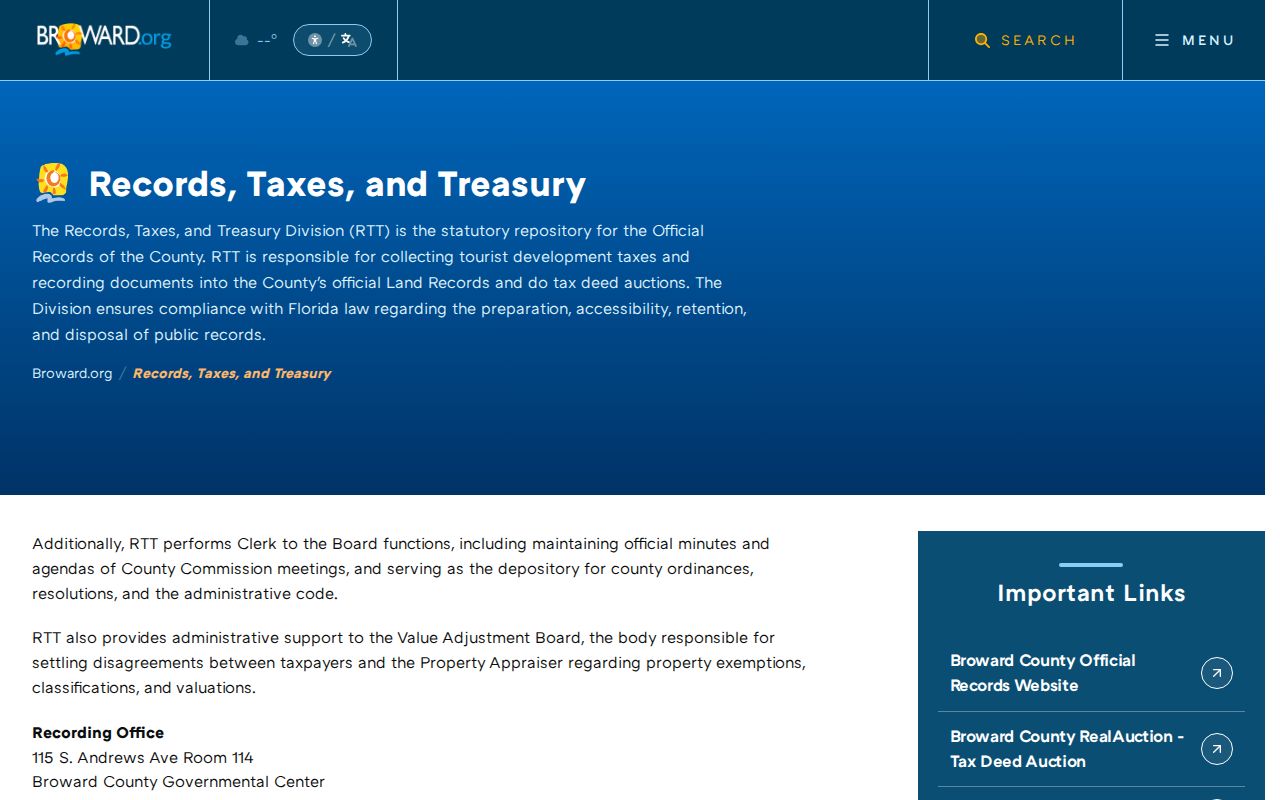
This county route carries the address history past Acclaim's online limits.
Continue Lauderhill Records Offline
The Search and Copy Section is at the Broward County Governmental Center, 115 S. Andrews Avenue in Fort Lauderdale. Its call center is 954-831-4000, but statutory searches are not performed by phone, fax, or email. A mail request should state the instrument or CIN, book and page, document description, and copy count, then include payment to the Broward County Board of County Commissioners and a self-addressed stamped envelope.
A name search costs $2 per name for each year searched. An ordinary official-record copy up to standard legal size costs $1 per page, and certification costs $2 per instrument. An oversize map or plat copy is $5 per page. Ask for a certified copy only when an authenticated record is needed; a browser image or ordinary copy is often enough for family or house-history notes.
Search both party roles and name variants. Initials, married names, trust wording, and entity punctuation can split one transfer chain across separate results. The legal description is the best safeguard against joining two people with the same surname.
Find Lauderhill Past Households
Deeds identify owners, not all previous residents. Reverse directories, alphabetical directories, and the federal census can add an occupant layer. Broward County Library offers branch access to Ancestry, Fold3 directories, historical newspapers, and other genealogy tools. Special Collections can help with scans or research visits when an item is not online.
Exact publisher and year runs for a Lauderhill criss-cross series were not verified. Search catalog titles for Fort Lauderdale and vicinity, Greater Fort Lauderdale, Broward County, Polk, Hill-Donnelly, telephone directories, and reverse directories. Lauderhill incorporated after the latest public census, so older residents may be filed under a subdivision, unincorporated Broward, or a broader place label. The collections themselves are treated on the Lauderhill city directories page.
- Find the address in a reverse street section, then copy the printed occupant and edition year.
- Check the alphabetical entry and its abbreviation key for spouse, occupation, phone, or owner-renter marks.
- Compare the editions before and after it to bracket the first and last appearances.
- Use enumeration maps and nearby names to locate the household in the closest public census year.
- Confirm the parcel through a plat or deed and explain any owner-occupant difference.
Date a Lauderhill House Carefully
Maps and permits answer questions that a directory cannot. Digital Sanborn Maps is available through the NSU e-card route, but exact Lauderhill sheet years were not verified. A Sanborn map can show a structure's footprint, materials, use, and street layout. It does not name a household.
City permit instructions tie work address to folio and a current utility map. A permit file may name an owner, applicant, contractor, and work dates. Yet the current search fields and first online year were not confirmed. Ask Lauderhill Development Services for existing permit cards, applications, inspection histories, and related files for a specific folio and date span. The City Clerk's public-record channel is the fallback if a department page lacks the record.
Pair the building or effective year on BCPA with permits, old aerials, maps, directories, and deeds. None alone proves when a family arrived. Agreement among dated sources makes the address history stronger.
Close Lauderhill Resident Trails
Probate and obituaries can explain the end of a resident's tie to an address. Broward Clerk probate dockets may identify a decedent, personal representative, petitioner, counsel, heirs, or other interested people. Some filings and personal identifiers remain confidential. Use a Web2 case number to request a missing public filing from the clerk.
Newspaper databases at Broward County Library can add obituaries, death notices, estate notices, property ads, club items, and family announcements. Search the street address, spouse, employer, subdivision, and name variants. Optical character recognition often misses old multi-column print, so inspect the page image and try a well-scanned neighbor's name when the target surname fails.
Florida County Marriages, 1830-1957, and Florida Probate Records, 1784-1990, are statewide FamilySearch collection titles. Their date spans do not guarantee Broward coverage. Check the film, volume, provenance, date, and camera icon before relying on an entry.
Before Lauderhill Was a City
Lauderhill became a city on June 20, 1959. Broward County formed on October 1, 1915 from northern Dade and southern Palm Beach territory. Previous-resident work before those dates must test the period's real geography. A missing result under the modern city or county name may point to a catalog label, not a lost record.
Broward's surviving government files also traveled. A major archival transfer begun in 1983 moved records from the 1928 courthouse clock tower to Judge L. Clayton Nance Library, then West Side Grade School, and later the Historical Archives at Main Library. No reliable source found a catastrophic courthouse fire that erased a Lauderhill-era series.
This history explains why office media can predate the county government that now keeps them. Custody and creation are not the same fact. Search predecessor geography, contemporary plats, enumeration maps, and period place names before declaring a gap.
Use Lauderhill Previous Residents Lawfully
Past residents may still be living. Public deeds, directories, and court indexes do not grant permission to contact, monitor, or expose anyone. Record only what serves a lawful family-history, estate, house-history, civic, or personal research purpose. When a source conflicts with another, report the conflict and verify it with the custodian.
A parcel owner is not always an occupant. A directory omission may reflect a canvass gap, and a census entry reflects one enumeration date. Protected addresses and restricted records can be absent by law. Those limits are part of the evidence.
Lawful use. Use Lauderhill previous-resident records for legitimate personal research. Never use them to track, stalk, harass, intimidate, or harm a living person.
Keep a source log with the URL or office, search date, record date, exact role, parcel identity, and copy type. That short habit keeps past residents from being merged with owners, relatives, or namesakes.